
SpaceX Smashes Launchpad Turnaround Record at Cape Canaveral
SpaceX has set a new benchmark in launch operations, reusing the same Cape Canaveral pad in just 45 hours as it continues to scale Starlink deployments at record speed.
1/15/20263 min read
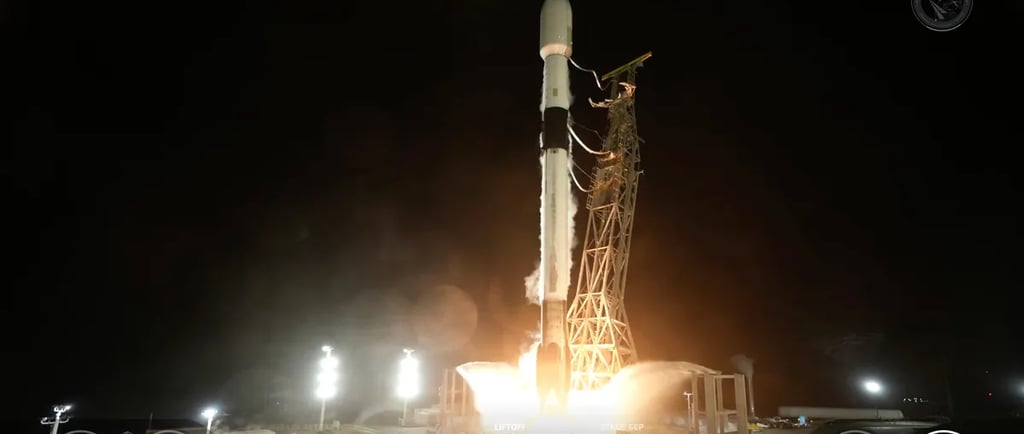
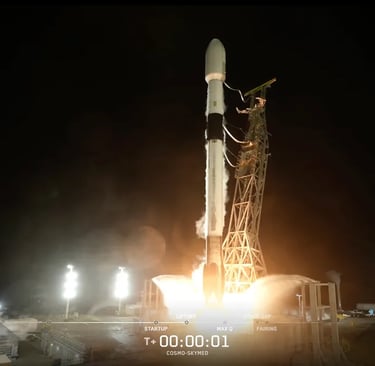
SpaceX has once again redefined what is possible in modern spaceflight, breaking its own launchpad turnaround record at Cape Canaveral Space Force Station with a rapid back-to-back Falcon 9 mission. On Wednesday afternoon, the company successfully launched the Starlink 6-98 mission just 45 hours after the same pad was used for a previous Starlink flight—surpassing the earlier record by more than five hours.
The Falcon 9 rocket lifted off at 1:08 p.m. Eastern Time, carrying 29 Starlink V2 Mini Optimized satellites into low Earth orbit. The launch followed closely on the heels of the Starlink 6-97 mission, which departed from the same launch complex late Monday afternoon. This exceptionally short interval highlights how SpaceX’s reusable rocket strategy has matured from an experimental concept into a highly reliable operational system.
A New Standard for Launchpad Efficiency
Until now, SpaceX’s fastest turnaround between launches from the same pad stood at just over 50 hours, a record set in December 2025. By cutting that time down to 45 hours, SpaceX has demonstrated that rapid launch cadence is no longer an aspirational goal, but an achievable reality.
According to company officials, the rocket itself was technically ready to fly even sooner. SpaceX Vice President of Launch, Kiko Dontchev, noted that the vehicle was prepared at around the 40-hour mark, but the mission team waited for the most precise orbital deployment window. He emphasized that physics—not operations—is increasingly becoming the only true limitation in launch scheduling.
Why Faster Turnarounds Matter
Launchpad turnaround time has long been one of the bottlenecks in orbital launch operations. After each mission, teams must inspect infrastructure, repair heat and acoustic damage, reset fueling systems, and certify safety before another rocket can fly. Historically, this process took weeks or even months.
SpaceX’s ability to compress that timeline into under two days represents a fundamental shift in spaceflight economics. Faster turnarounds reduce costs, increase launch availability, and allow satellite operators to deploy constellations at unprecedented speed. For SpaceX, this directly supports the rapid expansion of its Starlink internet network, which now includes thousands of satellites serving users worldwide.
Starlink 6-98: Mission Overview
The Starlink 6-98 mission added 29 next-generation satellites to SpaceX’s growing low Earth orbit constellation. These V2 Mini Optimized satellites are designed to deliver higher bandwidth, improved latency, and better overall performance compared to earlier Starlink models.
This launch marked SpaceX’s fourth Starlink mission of 2026 and its sixth Falcon 9 flight of the year, underscoring the company’s aggressive launch schedule.
The Veteran Booster Behind the Mission
Powering the mission was Falcon 9 first-stage booster B1085, a workhorse vehicle making its 13th flight. The booster has previously supported a diverse range of missions, including crewed spaceflight, lunar payload deliveries, and commercial launches.
Approximately eight and a half minutes after liftoff, B1085 executed a precise landing on the SpaceX drone ship A Shortfall of Gravitas, stationed in the Atlantic Ocean. This successful recovery marked the 139th landing on that vessel and the 559th booster landing in SpaceX’s history—figures that would have seemed unimaginable just a decade ago.
Reusable boosters remain the backbone of SpaceX’s launch dominance, enabling the company to fly frequently while maintaining safety and reliability.
Engineering Over Tradition
What makes this milestone particularly significant is how dramatically it contrasts with traditional aerospace thinking. For decades, rapid reuse was considered unrealistic, if not unsafe. SpaceX has steadily overturned those assumptions through iterative engineering, data-driven decision-making, and automation.
Dontchev reflected on this shift by noting that what once felt “crazy” now feels routine. Launching from the same pad multiple times per week—or even per day—has moved from science fiction into practical engineering.
Looking Ahead
As SpaceX continues to push launch cadence higher, industry observers expect further records to fall. The company’s long-term ambitions—including fully reusable Starship missions and deep-space exploration—will likely depend on the same operational efficiencies now being refined with Falcon 9.
For now, the Cape Canaveral turnaround milestone serves as a clear signal: orbital launch is entering an era defined by speed, scale, and repeatability. SpaceX isn’t just launching rockets—it’s redefining the rhythm of spaceflight itself.
References
SpaceX. “Falcon 9 Launches and Landings.” SpaceX, www.spacex.com.
U.S. Federal Aviation Administration. “Commercial Space Transportation Reports.” FAA, www.faa.gov.
Berger, Eric. “How SpaceX Made Rapid Rocket Reuse Routine.” Ars Technica, www.arstechnica.com.
Wall, Mike. “Starlink and the Future of Satellite Internet.” Space.com, www.space.com.