
SpaceX Launches Italy's Satellite with Falcon 9
SpaceX kicks off 2026 with a flawless Falcon 9 mission, successfully deploying Italy’s advanced earth-observation satellite. This launch highlights record-setting reusability and SpaceX's dominance in the aerospace industry.
1/4/20263 min read
(Image credit: SpaceX)
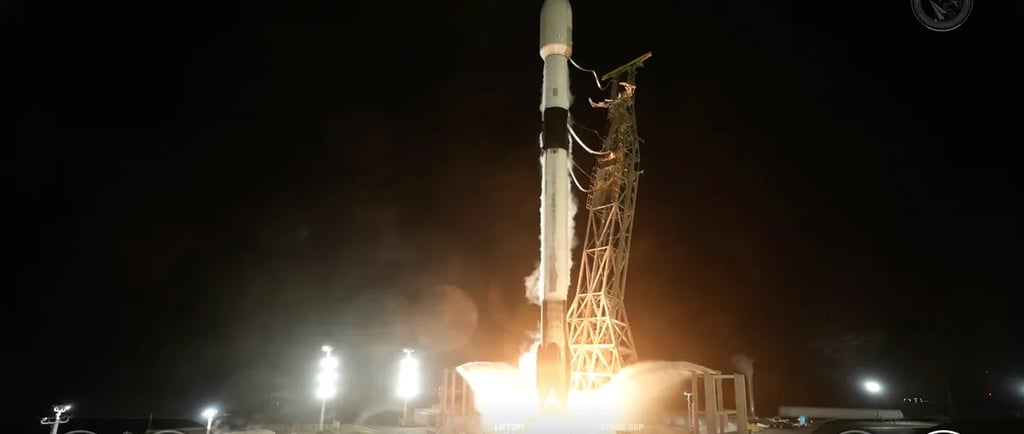
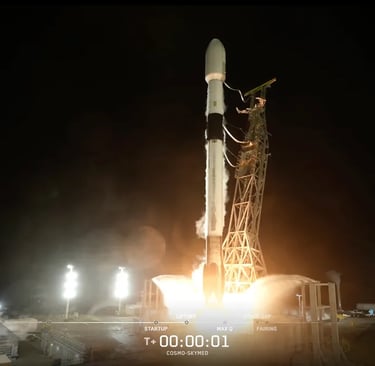
SpaceX has started 2026 exactly where it left off—by redefining what consistency and efficiency look like in modern spaceflight. On the night of January 2, a Falcon 9 rocket lifted off from Vandenberg Space Force Base in California, carrying an advanced Italian Earth-observing satellite into orbit. The launch marked not only SpaceX’s first mission of the new year, but also the first orbital launch globally in 2026, setting an ambitious tone for the months ahead.
The rocket soared into the night sky at 9:09 p.m. Eastern Time, delivering its payload precisely as planned. Roughly 8.5 minutes after liftoff, the Falcon 9’s first stage returned safely to Earth, landing back at Vandenberg. According to SpaceX, this booster was completing its 21st successful flight, underscoring the company’s unmatched expertise in rocket reusability.
A Key Satellite for Earth Monitoring
The payload aboard this mission was part of Italy’s COSMO-SkyMed Second Generation satellite program—one of Europe’s most advanced Earth-observation systems. These satellites use high-resolution radar imaging to monitor Earth’s surface regardless of weather or daylight conditions.
Such capabilities are critical for environmental monitoring, disaster response, climate research, and national security. Radar-based satellites like COSMO-SkyMed can detect subtle changes in land movement, track floods and wildfires, and provide vital data following earthquakes or landslides.
(Internal link opportunity: hyperlink here to your previously published article on climate monitoring satellites or space-based disaster tracking.)
This mission marked the third satellite launched under the COSMO-SkyMed Second Generation initiative. The first was deployed in 2019 using a Soyuz rocket, while the second launched aboard a Falcon 9 in early 2022—highlighting Europe’s growing collaboration with SpaceX.
Falcon 9 Reusability: The Industry Standard
What once seemed experimental has now become routine. The booster used in this mission has flown 21 times, carrying everything from commercial satellites to scientific instruments. Each successful landing reduces launch costs, shortens turnaround times, and lowers the environmental footprint of spaceflight.
NASA and independent aerospace analysts have repeatedly noted that reusable rockets are reshaping the economics of space access (NASA). SpaceX’s Falcon 9 remains the most frequently flown orbital rocket in history, and its reliability continues to attract government and international clients.
SpaceX’s Record-Breaking Momentum
This launch follows an unprecedented year for SpaceX. In 2025 alone, the company completed 165 orbital missions, a number that eclipsed the combined launch totals of many spacefaring nations. Those missions accounted for roughly 85% of all US orbital launches, reinforcing SpaceX’s dominance in the global aerospace sector.
The January 2026 launch demonstrates that SpaceX has no intention of slowing down. With missions spanning Starlink internet deployment, national security payloads, scientific research, and international partnerships, the company has become the backbone of modern orbital logistics.
Why Vandenberg Matters
Vandenberg Space Force Base plays a crucial role in Earth-observation missions. Located on California’s coast, it allows rockets to launch southward over the Pacific Ocean into polar and sun-synchronous orbits—ideal for satellites designed to scan the entire Earth systematically.
These orbits enable satellites like COSMO-SkyMed to pass over the same locations at consistent times, improving data accuracy for climate science and environmental monitoring (European Space Agency).
A Glimpse Into 2026 and Beyond
Industry experts expect 2026 to be another historic year for SpaceX. Alongside continued Falcon 9 missions, attention is growing around Starship, the fully reusable heavy-lift rocket designed for lunar missions and eventual human exploration of Mars.
While Starship is still undergoing test flights, its progress suggests that SpaceX could soon expand beyond Earth orbit in ways never achieved before.
Redefining the Global Space Race
SpaceX’s rapid cadence has changed expectations across the aerospace industry. Governments, startups, and international agencies now measure success not just by launches completed—but by speed, reliability, and reusability.
This Italian satellite mission exemplifies how private companies are enabling scientific progress worldwide. As space becomes increasingly central to communication, climate resilience, and security, SpaceX’s role continues to grow.
Final Thoughts
The first launch of 2026 was more than a routine mission—it was a statement. With flawless execution, advanced payload deployment, and another successful booster recovery, SpaceX reaffirmed its position at the forefront of space innovation.
As the year unfolds, all signs point to another chapter of rapid expansion, technological milestones, and global collaboration—launched, quite literally, at rocket speed.
3. References
NASA. Reusable Launch Vehicles and the Future of Spaceflight. NASA, www.nasa.gov.
European Space Agency. COSMO-SkyMed Earth Observation System. ESA, www.esa.int.
SpaceX. Falcon 9 Overview. SpaceX, www.spacex.com.
U.S. Space Force. Vandenberg Space Force Base Mission Overview. spaceforce.mil.