
NASA Telescope SPHEREx Maps the Universe in 102 Colors
NASA telescope Spherex has successfully completed its first full-sky infrared map, revealing 102 colors of the universe and providing new insights into cosmic origins, galaxy evolution, and the fundamental building blocks of life.
12/20/20253 min read
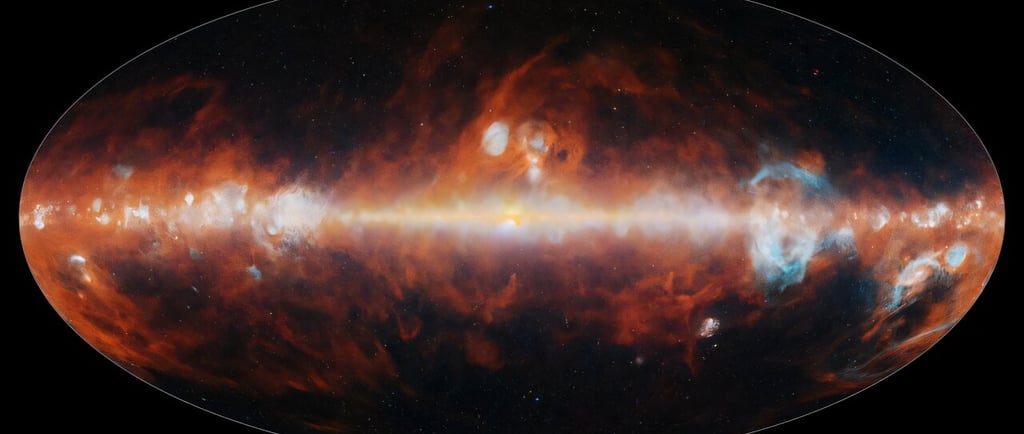
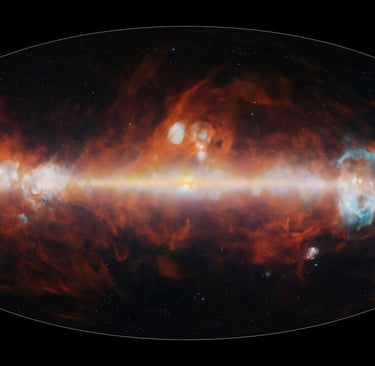
Picture credit: NASA/JPL-Caltech
NASA has reached a major milestone in space exploration with the successful completion of the first full-sky infrared map created by the SPHEREx space telescope. Launched in March, SPHEREx has spent just six months scanning the cosmos, capturing the entire sky in 102 distinct infrared wavelengths—a level of detail never before achieved in an all-sky survey (NASA).
Although invisible to the human eye, infrared light dominates much of the universe. By observing the sky in these wavelengths, SPHEREx is offering scientists a powerful new way to study how the universe began, how galaxies evolved over nearly 14 billion years, and where the essential ingredients for life may be distributed within our own Milky Way.
A New Way to See the Universe
SPHEREx—short for Spectro-Photometer for the History of the Universe, Epoch of Reionization, and Ices Explorer—orbits Earth approximately 14.5 times per day, traveling from pole to pole. Each day, it captures roughly 3,600 images, slowly building a circular strip of sky. As Earth moves around the Sun, SPHEREx’s viewing angle shifts, allowing it to scan new regions of space (Jet Propulsion Laboratory).
After six months of continuous observation, the telescope has now mapped the entire sky in 360 degrees. This achievement marks the completion of SPHEREx’s first all-sky mosaic, finalized in December. Over its two-year primary mission, SPHEREx will repeat this process three more times, with each scan increasing the sensitivity and accuracy of the data.
Crucially, the entire dataset is being made freely available to scientists and the public worldwide, reinforcing NASA’s commitment to open science.
Why 102 Colors Matter
Each of SPHEREx’s 102 colors represents a specific wavelength of infrared light, and each wavelength carries unique physical information. Certain wavelengths reveal star-forming regions hidden behind dense cosmic dust, while others expose cold molecular clouds or ancient galaxies billions of light-years away (Fabinsky).
This technique—known as spectroscopy—allows scientists to break light into its component colors, much like a prism splits visible light into a rainbow. While spectroscopy has been used in space missions before, no previous telescope has combined such a wide field of view with so many wavelengths in a full-sky survey.
NASA’s James Webb Space Telescope can observe far more wavelengths, but only in very small patches of the sky. SPHEREx fills the gap by offering a cosmic-wide perspective, making it a perfect complement to Webb and other observatories (NASA Astrophysics Division).
Mapping the Universe in Three Dimensions
One of SPHEREx’s most ambitious goals is to measure the distances to hundreds of millions of galaxies. While many of these galaxies are already mapped in two dimensions, SPHEREx adds depth, creating a three-dimensional map of the universe.
This 3D structure allows scientists to study how galaxies cluster across cosmic time. Subtle variations in this clustering pattern hold clues about a mysterious event that occurred almost instantly after the Big Bang—an event known as cosmic inflation (Jenniskens).
During inflation, the universe expanded at an unfathomable rate in the first billionth of a trillionth of a trillionth of a second, stretching tiny quantum fluctuations into the large-scale structures we observe today. Understanding inflation remains one of the biggest challenges in modern physics, and SPHEREx provides a new observational approach to tackle it.
A Telescope with “Superpowers”
To achieve its unprecedented view, SPHEREx uses six infrared detectors, each equipped with a specialized filter containing a gradient of 17 colors. Together, this setup allows every single image to capture all 102 wavelengths simultaneously.
As a result, each all-sky map is actually 102 overlapping maps, each highlighting different physical properties of cosmic objects. Dense dust clouds that appear dark in visible light often glow brightly in infrared, revealing hidden regions where stars and planets are forming (IAU).
Beth Fabinsky, SPHEREx project manager at NASA’s Jet Propulsion Laboratory, famously compared the telescope to a mantis shrimp—a creature known for its extraordinary color vision. The analogy captures SPHEREx’s ability to see the universe in ways no human eye ever could.
Searching for the Ingredients of Life
Beyond cosmology, SPHEREx will help scientists study the distribution of water ice and organic molecules in the Milky Way. These chemical building blocks are essential for life as we know it and play a key role in the formation of planets (NASA).
By mapping where these materials exist in star-forming regions, SPHEREx can help researchers understand how planetary systems—including our own—come together.
Big Science, Global Impact
“SPHEREx is a mid-sized mission delivering big science,” said Dave Gallagher, Director of NASA’s Jet Propulsion Laboratory. The mission exemplifies how advanced engineering, innovative design, and open data can work together to push the boundaries of human knowledge.
With four complete all-sky scans planned and global access to its data, SPHEREx is expected to influence astronomical research for decades to come.
References
Fabinsky, Beth. SPHEREx Project Overview. Jet Propulsion Laboratory, NASA, www.jpl.nasa.gov.
International Astronomical Union. Infrared Astronomy and Star Formation. IAU, www.iau.org.
Jenniskens, Peter. Cosmic Inflation and Large-Scale Structure. Cambridge University Press, 2006.
NASA. SPHEREx Mission Overview. National Aeronautics and Space Administration, www.nasa.gov.
NASA Astrophysics Division. Exploring the Universe in Infrared. NASA Headquarters, Washington, DC.