
Mars Sand Formations Observed by Perseverance Rover
NASA's Perseverance Rover has captured detailed images of massive wind-shaped sand formations on Mars, providing insights into ancient atmospheres, hidden water interactions, and the prospects for human exploration on the red planet.
1/8/20263 min read
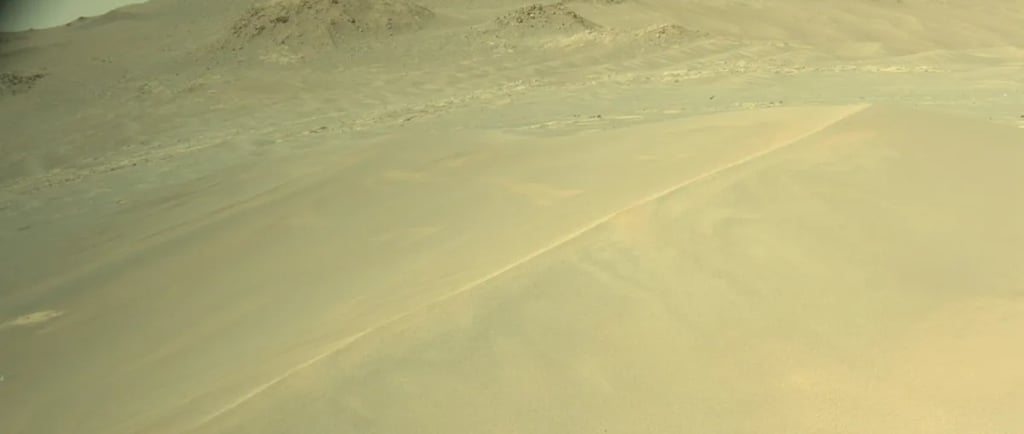
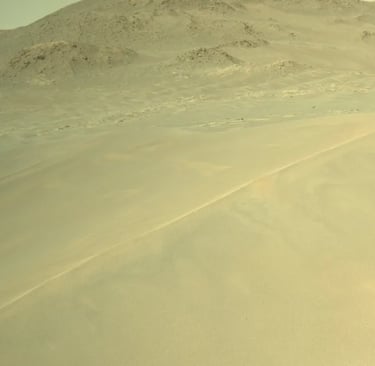
Image credit: NASA/JPL-Caltech)
NASA’s Perseverance rover has delivered its most detailed examination yet of an unusual and striking feature on Mars: giant wind-shaped sand formations known as aeolian megaripples. These oversized ripples, some rising nearly 6.5 feet (around 2 meters) tall, were recently observed near the rim of Jezero Crater, the ancient lakebed Perseverance has been exploring since landing in February 2021.
Unlike the smaller sand ripples commonly seen on Earth, these Martian megaripples appear surprisingly stable. Scientists believe they may act as natural archives, preserving evidence of long-past wind patterns and atmospheric conditions on the Red Planet (NASA Jet Propulsion Laboratory).
What Makes Martian Megaripples Different?
On Earth, wind constantly reshapes sandy landscapes, causing dunes and ripples to migrate over time. Mars, however, tells a more complex story. Despite having an atmosphere that is less than 1% as dense as Earth’s, wind remains one of the planet’s most powerful geological forces, capable of grinding rock into sand and moving it across vast distances.
Megaripples stand apart because they often resist motion. According to the Perseverance science team, interactions between atmospheric moisture and fine dust can form a thin, salty crust on the surface of these ripples. This crust increases cohesion between sand grains, effectively “cementing” them together and making the structures difficult for typical Martian winds to shift (Lapôtre et al.).
This discovery helps explain why many Martian megaripples appear largely unchanged for long periods, earning them a reputation as mostly inactive features rather than constantly evolving landforms.
Meet “Hazyview”: A Giant Ripple with a Story to Tell
One particularly intriguing megaripple, nicknamed “Hazyview,” was identified in the Honeyguide ripple field, a sandy region near Jezero Crater’s rim. Perseverance devoted exceptional attention to this site, collecting more than 50 separate observations using a broad suite of scientific instruments.
These included Mastcam-Z for high-resolution imaging, SuperCam for chemical analysis, MEDA for environmental measurements, and PIXL and WATSON for microscopic surface studies. Together, these tools allowed scientists to investigate the ripple’s internal structure, surface chemistry, and potential signs of movement.
Are These Sand Giants Truly Dormant?
While many megaripples appear locked in place, researchers have noticed subtle signs of activity in some regions. This raises the possibility that rare periods of intense wind could break down surface crusts, partially reactivating the sand beneath.
If confirmed, such activity would suggest that modern Mars — despite its cold temperatures and thin atmosphere — still undergoes meaningful surface changes. This challenges the long-held view of Mars as a largely frozen and geologically quiet world (Baker et al.).
Understanding whether these ripples are permanently stable or occasionally mobile is critical for interpreting Mars’ recent climate history.
Why Studying Sand Matters More Than You Think
At first glance, investigating sand ripples may seem secondary to the rover’s primary mission of searching for signs of ancient microbial life. In reality, these formations are deeply connected to both scientific discovery and future human exploration.
From a scientific standpoint, megaripples preserve a record of past wind regimes and water-dust interactions. They provide insight into how Mars transitioned from a wetter, thicker-atmosphered planet into the cold desert world we see today.
Preparing for Future Missions to Mars
Beyond scientific curiosity, Martian soil behavior has practical consequences. The chemistry, cohesion, and movement of surface materials affect:
Rover and vehicle traction
Dust accumulation on equipment
Stability of landing sites
Potential access to in-situ resources for future astronauts
By studying megaripples like Hazyview, mission planners gain crucial knowledge that will shape how humans eventually live and work on Mars.
As Perseverance continues its journey, each grain of sand it studies brings scientists closer to understanding both Mars’ ancient past and humanity’s interplanetary future.
References
NASA Jet Propulsion Laboratory. “Perseverance Rover Studies Giant Wind-Shaped Sand Ripples on Mars.” NASA, 2025, www.nasa.gov.
Lapôtre, Mathieu G. A., et al. “Large Wind Ripples on Mars: Evidence for Active Surface Processes.” Nature Geoscience, vol. 11, no. 10, 2018, pp. 781–786.
Baker, Victor R., et al. “Aeolian Processes and Climate Change on Mars.” Journal of Geophysical Research: Planets, vol. 125, no. 6, 2020.