
Ancient Comet 3i/Atlas Glows Green After Sun Encounter
Discover the stunning transformation of the ancient comet 3i/Atlas as it glows green following its close encounter with the sun. A new image from the Gemini Telescope reveals rare changes in this fascinating celestial object.
1/7/20263 min read
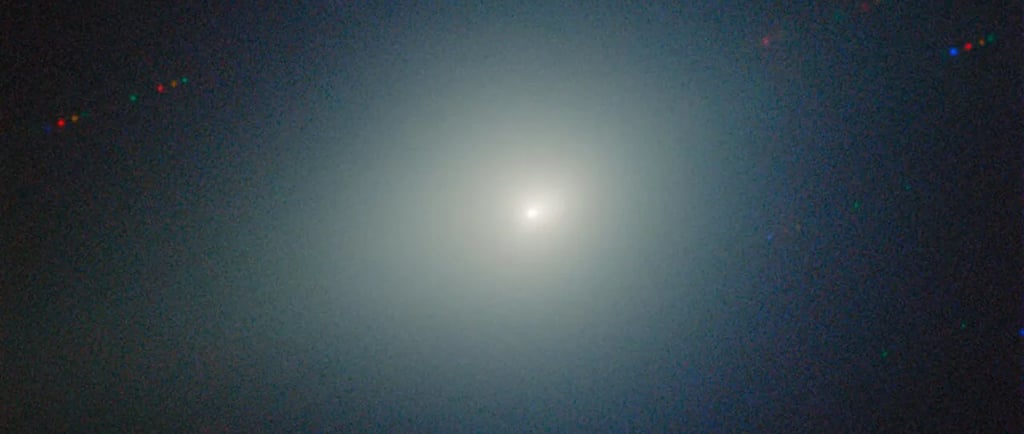
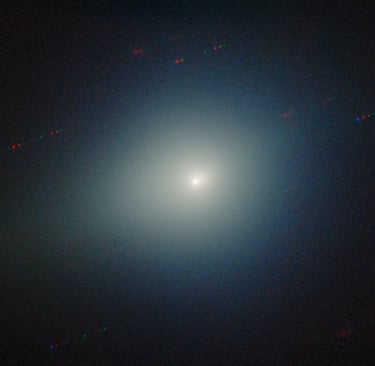
Credit: International Gemini Observatory/NOIRLab/NSF/AURA/B. Bolin.
A newly released image from the Gemini North telescope has captured comet 3I/ATLAS displaying an unusual green glow—an effect scientists say was triggered by its recent close approach to the Sun. The image offers rare insight into how interstellar objects behave when exposed to solar heat for the first time.
Discovered in 2025, comet 3I/ATLAS quickly drew global attention because it did not originate within our Solar System. Instead, it formed around a distant star and wandered through interstellar space for billions of years before briefly entering our cosmic neighborhood. Astronomers believe it may be the oldest comet ever observed, making it only the third confirmed interstellar object detected to date, following ‘Oumuamua and 2I/Borisov.
A Rare Visitor That Won’t Stay
Unlike typical comets that orbit the Sun in predictable paths, 3I/ATLAS is merely passing through. After its journey through the inner Solar System, it will continue onward into deep space—never to return. This fleeting visit makes every observation especially valuable.
The latest image was captured after the comet emerged from behind the Sun in late November 2025. Astronomers used the Gemini Multi-Object Spectrograph (GMOS) at the Gemini North telescope, located atop Maunakea in Hawaii, one of the world’s most powerful ground-based observatories.
Because the comet moves rapidly relative to background stars, the telescope had to precisely track its motion during long exposures. While stars initially appeared as streaks, scientists processed the final image to restore clarity—keeping the comet sharply in focus.
Why Is the Comet Glowing Green?
Earlier observations of 3I/ATLAS taken by the Gemini South telescope in Chile showed the comet glowing reddish in color. In contrast, the newest images reveal a striking green hue.
According to astronomers, this color shift is caused by diatomic carbon gas (C₂) released as the comet heats up near the Sun. When ultraviolet sunlight excites these gas molecules, they emit light at green wavelengths—a phenomenon commonly observed in comets but especially intriguing in one formed beyond our Solar System (Bolin et al.).
As frozen gases deep within the comet sublimate, they create a glowing cloud known as a coma, which surrounds the nucleus and reflects the object’s changing chemistry.
A Window Into Another Star System
Because 3I/ATLAS formed around a different star, its composition may be fundamentally different from comets native to our Solar System. Studying its gases, dust, and reactions to solar heat allows scientists to compare planetary formation processes across star systems.
Researchers note that some comets experience delayed outgassing, meaning they can continue releasing gases long after passing the Sun, as heat slowly penetrates their interiors (Jewitt). Continued monitoring will determine whether 3I/ATLAS shows similar behavior as it cools while exiting the Solar System.
Science for the Public Eye
The Gemini observations were conducted as part of a public outreach initiative by NSF NOIRLab, emphasizing transparency in astronomical research.
According to Eureka Scientific researcher Bryce Bolin, the outstanding observing conditions offer the public a rare opportunity to witness an interstellar visitor as if they were right alongside astronomers.
By releasing high-resolution images and detailed explanations, astronomers hope to demystify how space science works—from data collection to image processing—while inspiring curiosity about the universe beyond Earth.
Why This Discovery Matters
Interstellar bodies such as 3I/ATLAS are not just rare sights in the sky, but valuable sources of scientific discovery. They are time capsules, preserving material from environments far older than our Sun. Each one offers a rare chance to study alien planetary systems without leaving Earth.
As detection technology improves, scientists expect to discover more interstellar visitors in the coming decades. For now, 3I/ATLAS remains a reminder that our Solar System is not isolated—but part of a much larger, dynamic cosmic ecosystem.
References
Bolin, Bryce, et al. “Gemini Observations of Interstellar Comet 3I/ATLAS.” NSF NOIRLab, 2025.
Jewitt, David. “The Active Evolution of Comets.” Annual Review of Earth and Planetary Sciences, vol. 48, 2020, pp. 113–139.
National Science Foundation NOIRLab. “Public Outreach Imaging of Interstellar Objects.” NSF.gov, 2025.
Meech, Karen J., et al. “Interstellar Comets and What They Reveal About Planetary Systems.” Nature Astronomy, vol. 7, 2023, pp. 1–9.