

Humans Walking Upright: Fossil Discovery Insights
A groundbreaking fossil discovery suggests that humans may have started walking upright nearly seven million years ago, reshaping our understanding of the origin of humans and their evolutionary journey.
1/4/20263 min read

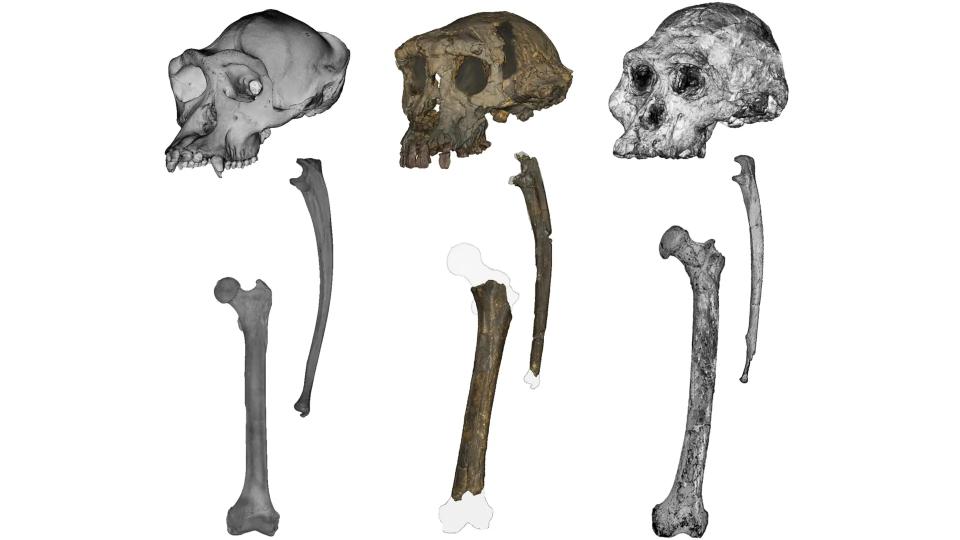
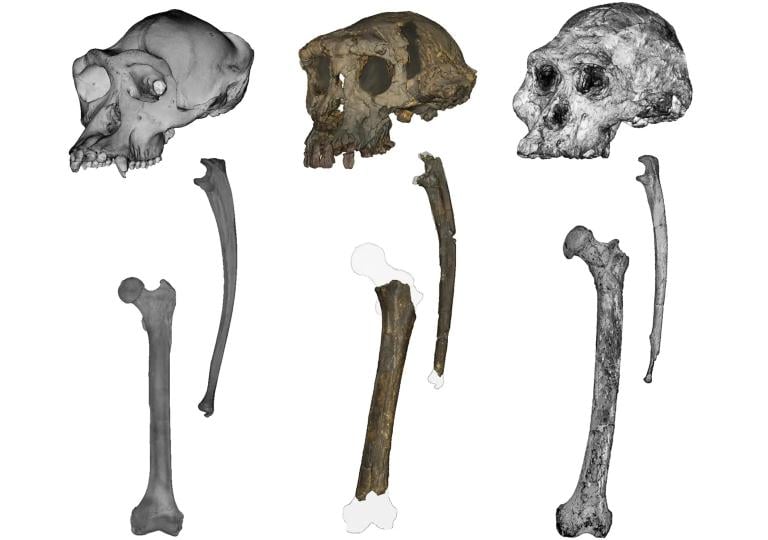
Credit: Scott Williams/NYU and Jason Heaton/University of Alabama Birmingham
For decades, scientists have debated one of the biggest questions in human history: when did our ancestors first begin walking upright? A recent scientific breakthrough suggests the answer may lie much deeper in the past than previously believed.
A fossil dating back nearly seven million years, known as Sahelanthropus tchadensis, is now offering compelling evidence that early human relatives may have walked on two legs far earlier than scientists once imagined. If confirmed, this discovery reshapes the timeline of human evolution and challenges long-held assumptions about what our earliest ancestors looked like and how they moved.
Why This Fossil Matters
Sahelanthropus tchadensis was first discovered in the Djurab Desert of Chad in the early 2000s. Initially, researchers focused mainly on its skull, which showed a mix of ape-like and human-like features. While intriguing, the skull alone could not answer one crucial question: Was this species capable of walking upright?

The Bone Clue That Changed Everything
In a study published in Science Advances, researchers used advanced 3D imaging and biomechanical analysis to re-examine fossilized bones associated with Sahelanthropus. Their focus was on a subtle but powerful anatomical feature: a femoral tubercle.
This structure serves as the attachment point for the iliofemoral ligament, the strongest ligament in the human body. In modern humans, this ligament plays a vital role in stabilizing the hip during standing and walking. Importantly, this feature has only been observed in species that walk upright.
Its presence in Sahelanthropus strongly suggests that this ancient species was adapted for bipedal movement—millions of years earlier than previously thought (Williams et al.).
Three Strong Signs of Upright Walking
The researchers identified three major anatomical traits that support the idea of early bipedalism:
1. Human-Like Hip Stability
The femoral tubercle anchors muscles and ligaments needed to keep the body balanced while standing upright, reducing the effort required to stay vertical.
2. Femoral Antetorsion
This natural twist in the thigh bone helps align the legs forward for efficient walking. The fossil’s femur falls within the same range seen in early human ancestors, not modern apes.
3. Gluteal Muscle Structure
3D modeling revealed buttock muscles similar to those found in early hominins, which help stabilize the pelvis during walking and running.
Together, these traits form a powerful case that Sahelanthropus was not just capable of upright posture—but actively used it on the ground.
👉 Internal link opportunity: Link to your article on *“How Human Anatomy Adapted for Walking and Running.”
Not Fully Human—But Not Fully Ape
Despite its ability to walk upright, Sahelanthropus still had a chimpanzee-sized brain and physical traits suggesting it spent time climbing trees. This combination tells a fascinating evolutionary story.
According to lead researcher Dr. Scott Williams (NYU), this species likely moved between trees and ground, using bipedal walking for travel while still relying on trees for food and safety.
This challenges the idea that upright walking only evolved after humans left forested environments. Instead, it suggests that bipedalism may have emerged while our ancestors were still partially tree-dwelling.
Limb Proportions Add More Evidence
The study also examined limb ratios. Apes typically have long arms and short legs, while humans show the opposite. Sahelanthropus displayed an intermediate pattern, with a longer femur compared to its forearm bones.
This places it closer to early human species like Australopithecus, including the famous fossil “Lucy,” dated between four and two million years ago.
👉 Internal link opportunity: Link to your article on *“Australopithecus and the Evolution of Early Humans.”
Why This Discovery Changes Human History
If Sahelanthropus tchadensis is confirmed as a hominin, it would become the earliest known human ancestor capable of bipedal walking. This pushes the origins of upright movement back by nearly a million years and suggests that the split between humans and chimpanzees happened earlier than previously believed.
More importantly, it shows that walking upright came before big brains, not the other way around—reshaping how scientists understand human evolution.
A Collaborative Scientific Effort
The study involved researchers from New York University, the University of Washington, Chaffey College, and the University of Chicago, and was funded by the U.S. National Science Foundation. Their findings mark a major step forward in understanding our deep past.
What Comes Next?
As imaging technology and fossil analysis continue to improve, scientists expect even more discoveries that could further refine the human evolutionary timeline. For now, Sahelanthropus stands as a powerful reminder that human history is far older—and more complex—than we once believed.
References
Williams, Scott A., et al. “Earliest Evidence of Hominin Bipedalism in Sahelanthropus tchadensis.” Science Advances, vol. 12, no. 1, 2026, doi:10.1126/sciadv.adv0130.
Smithsonian National Museum of Natural History. “Human Evolution Timeline.” Smithsonian Institution, www.si.edu.
National Geographic Society. “Human Evolution.” National Geographic, www.nationalgeographic.com.