
Sun Releases Powerful X-Class Solar Flares: What to Expect on Earth
A series of powerful X-class solar flares from the Sun has scientists watching closely for communication disruptions, satellite impacts, and intensified aurora displays as the solar maximum continues.
2/4/20263 min read
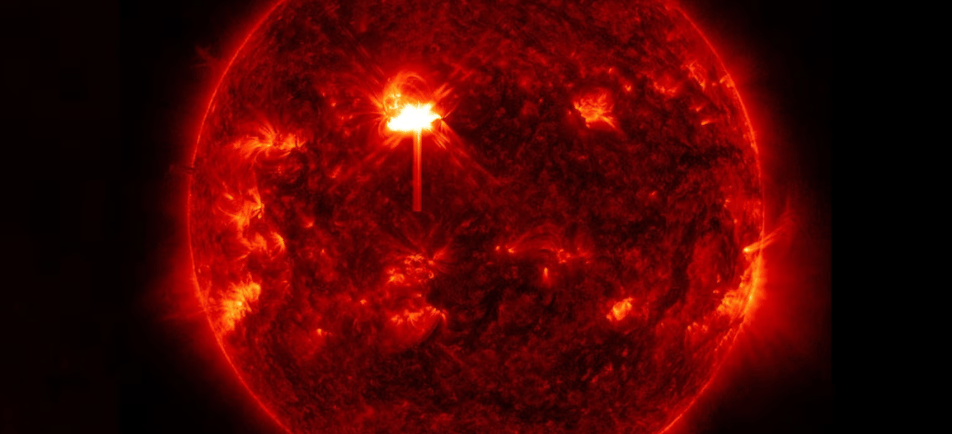
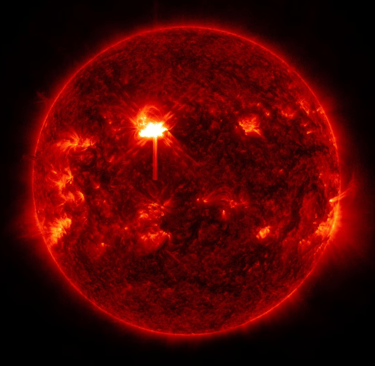
NASA/SDO
The Sun has entered a particularly active phase, releasing several powerful solar flares in recent days that have caught the attention of space-weather experts worldwide. These intense bursts of energy could lead to temporary acommunication disruptions, increased satellite interference, and enhanced displays of the Northern Lights across higher—and possibly mid—latitudes.
According to NASA, three major solar flares erupted on Sunday alone, occurring at 7:33 a.m., 6:37 p.m., and 7:36 p.m. Eastern Time. Each of these events was classified as an X-class flare, the most intense category used by scientists to measure solar flare strength.
What Makes These Solar Flares Unusual?
Solar flares are sudden explosions of electromagnetic radiation originating from regions of intense magnetic activity on the Sun’s surface, often near sunspots. While flares occur regularly, X-class flares are relatively rare and can have measurable effects on Earth’s space environment.
The most powerful of Sunday’s eruptions—an X8.1 flare—was the strongest recorded in several years, according to data from NASA and the National Oceanic and Atmospheric Administration (NOAA). Events of this magnitude are uncommon and typically occur near the peak of the Sun’s activity cycle .
How Solar Flares Affect Earth in Real Time
Unlike charged particles from other solar events, the electromagnetic radiation released during a solar flare travels at the speed of light. This means its effects can be felt on Earth within minutes.
NOAA reports that such flares can cause shortwave radio blackouts on the sunlit side of Earth, disrupting high-frequency communication systems used by aviation, maritime operations, and emergency services. These disruptions can last from several minutes to a few hours, depending on the flare’s intensity and duration .
Satellites operating in low Earth orbit may also experience temporary navigation errors or increased atmospheric drag during heightened solar activity.
From Solar Flares to Coronal Mass Ejections
Solar flares often precede another major solar phenomenon known as a Coronal Mass Ejection (CME). A CME involves a massive release of charged particles and magnetic fields from the Sun’s outer atmosphere, or corona.
If a CME is directed toward Earth, it can interact with our planet’s magnetic field, potentially triggering geomagnetic storms. These storms are responsible for some of the most dramatic space-weather effects—including vivid auroras and, in extreme cases, power grid disturbances.
Why Northern Lights May Become More Intense
Auroras occur when charged solar particles collide with gases in Earth’s upper atmosphere, causing them to emit light. Oxygen produces green and red hues, while nitrogen creates blue and purple tones.
Whether these recent flares result in visible auroras depends on several factors, including:
The direction and speed of any associated CME
The magnetic orientation of the CME’s field
Local weather conditions and cloud cover
When conditions align, auroras can be seen farther south than usual, sometimes reaching parts of the northern United States.
The Sun Has Reached Solar Maximum
Scientists attribute the recent surge in activity to the Sun reaching solar maximum—the most active phase of its 11-year solar cycle—in October 2024. During this period, the Sun’s magnetic field becomes unstable, leading to an increase in sunspots, flares, and geomagnetic storms.
NOAA predicts that heightened solar activity will continue through at least 2026, meaning more frequent space-weather events are likely in the coming years .
Should We Be Concerned?
For most people, solar flares pose no direct threat to health. Earth’s atmosphere and magnetic field provide strong protection against harmful radiation. However, modern society’s reliance on satellites, GPS, and wireless communication makes us more vulnerable to space-weather disruptions than in the past.
Space agencies and weather centers continuously monitor solar activity, allowing operators to take preventive measures such as placing satellites in safe mode or rerouting flights.
A Reminder of the Sun’s Influence
These recent solar flares serve as a reminder that Earth is deeply connected to the dynamic behavior of its star. As solar maximum continues, scientists expect more events that could both challenge modern technology and delight skywatchers with spectacular auroral displays.
Understanding and preparing for space weather is becoming increasingly important—not just for scientists, but for industries and societies that depend on reliable global communication and navigation systems.
References
National Aeronautics and Space Administration. “Solar Flares and Space Weather.” NASA, 2024.
National Oceanic and Atmospheric Administration. “X-Class Solar Flares and Radio Blackouts.” Space Weather Prediction Center, 2025.
Hathaway, David H. “The Solar Cycle.” Living Reviews in Solar Physics, vol. 12, no. 4, 2015.
Schrijver, C. J., et al. “Understanding Space Weather Impacts.” Journal of Geophysical Research: Space Physics, vol. 120, 2015.
NOAA Space Weather Prediction Center. “Solar Maximum and Geomagnetic Storm Forecasts.” 2024.