

Hubble Telescope Reveals Massive Planet-Forming Disk
NASA's Hubble Telescope has unveiled the largest and most turbulent planet-forming disk ever observed, providing unprecedented insights into the formation of worlds in extreme cosmic conditions.
12/24/20253 min read
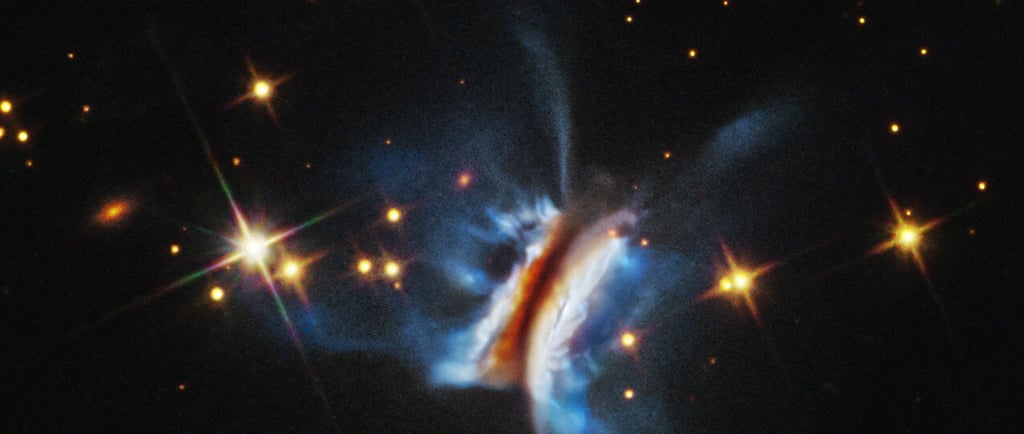
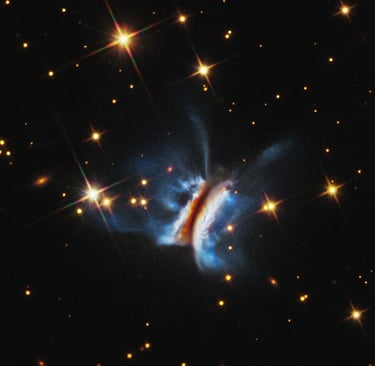
Credit: NASA, ESA, STScI, Kristina Monsch (CfA)
Astronomers have captured an extraordinary cosmic sight: the largest planet-forming disk ever observed, stretching nearly 400 billion miles across and displaying a level of chaos never before seen in visible light. Using NASA’s Hubble Space Telescope, scientists discovered that this massive disk is far more turbulent and asymmetric than traditional models of planet formation had predicted .
The system, officially known as IRAS 23077+6707 and informally nicknamed “Dracula’s Chivito,” lies about 1,000 light-years from Earth. The discovery marks a significant milestone in astronomy, offering scientists a rare opportunity to study how planets may form under extreme conditions .
A Planet Nursery Unlike Any Other
Protoplanetary disks—vast clouds of gas and dust surrounding young stars—are the birthplaces of planets. Over millions of years, material within these disks clumps together, eventually forming planets, moons, and other celestial bodies.
What makes IRAS 23077+6707 exceptional is its sheer scale. The disk is nearly 40 times wider than our solar system’s Kuiper Belt, making it the largest known planet nursery ever identified . Even more surprising is its structure: instead of appearing smooth and orderly, the disk is wildly chaotic, with wisps of dust stretching far above and below its main plane.
The disk is positioned almost edge-on from Earth’s perspective, blocking the central star from direct view. Astronomers believe the hidden star may be either a massive young star or possibly a pair of stars, adding further intrigue to the system.
Why Scientists Call It “Dracula’s Chivito”
The unusual nickname reflects both the disk’s appearance and the cultural backgrounds of the research team. One of the lead researchers has roots in Transylvania, while another comes from Uruguay, where a popular sandwich is called a chivito. When viewed edge-on, the disk resembles a glowing cosmic “burger,” with a dark central layer flanked by luminous top and bottom regions of dust and gas.
Despite the playful name, the science behind the discovery is serious—and groundbreaking.
A Puzzling Asymmetry That Defies Expectations
One of the most striking features of the disk is its uneven structure. Hubble’s images show tall, filament-like streams of material extending outward—but only on one side of the disk. The opposite side appears sharply cut off, with no comparable features visible.
This lopsidedness challenges long-standing assumptions that planet-forming disks are relatively symmetrical. Astronomers suspect that powerful forces—such as recent infall of gas, gravitational disturbances, or interactions with nearby interstellar material—may be shaping the disk’s unusual form .
According to researchers, these chaotic features suggest that planet formation can occur in far more dynamic and violent environments than previously believed.
Rethinking How Planets Are Born
All known planetary systems, including our own, originate from disks of gas and dust. Over time, material spirals inward toward the star, while leftover matter forms planets. In the case of IRAS 23077+6707, scientists estimate the disk contains 10 to 30 times the mass of Jupiter, providing enough material to potentially form multiple gas giant planets.
This discovery suggests that large-scale planetary systems may be more common in the universe than once thought. While planet formation in such massive disks may proceed differently, researchers believe the fundamental processes remain similar to those that shaped our solar system billions of years ago .
A New Laboratory for Cosmic Research
The ability to observe this disk in visible light gives astronomers a unique advantage. While NASA’s James Webb Space Telescope has observed similar disks in infrared wavelengths, Hubble’s sharp visible-light imaging allows scientists to trace fine details in dust structure and motion.
Researchers describe IRAS 23077+6707 as a natural laboratory, offering new clues about how gravity, turbulence, and environmental interactions influence planet formation over time.
What This Means for Our Understanding of the Universe
The discovery of Dracula’s Chivito highlights how much remains unknown about the early stages of planetary systems. It also reinforces the idea that our solar system may not be the standard model, but rather one example among many possible outcomes of cosmic evolution.
As astronomers continue to study this system with Hubble and future space telescopes, they hope to uncover how such extreme environments shape planets—and whether similar massive systems exist throughout the galaxy.
For now, one thing is clear: the universe is far more complex, chaotic, and creative than scientists once imagined.
References
Monsch, Kristina, et al. “Feeling Well, Functioning Well: Observations of an Extreme Protoplanetary Disk.” The Astrophysical Journal, 2024.
NASA. “Hubble Reveals Largest Protoplanetary Disk Ever Observed.” NASA.gov, 2024.
Bennett Lovell, Joshua, et al. “Asymmetric Structures in Massive Planet-Forming Disks.” Harvard & Smithsonian Center for Astrophysics, 2024.
National Aeronautics and Space Administration. Hubble Space Telescope Mission Overview, 2024.