
New Iron-Rich Structure in Ring Nebula Challenges Space Theories
A newly discovered iron-rich structure inside the iconic ring nebula is reshaping our understanding of stellar death and its potential to vaporize entire planets, prompting scientists to revisit theories on space phenomena.
1/23/20264 min read
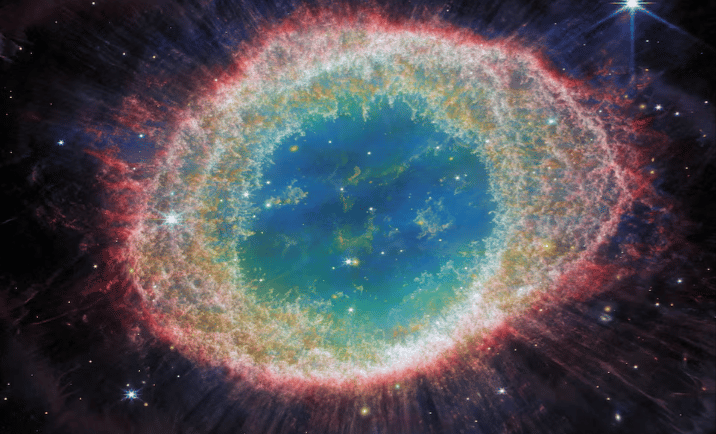
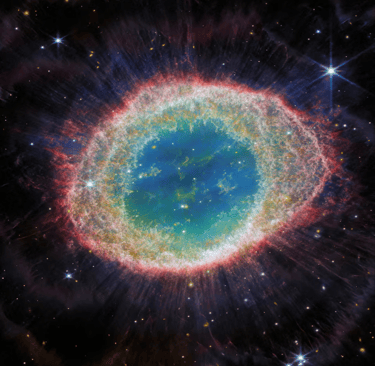
Picture Credit: NASA/ESA/Handout
For centuries, humanity has gazed at the night sky believing that the universe’s most familiar objects were also the most understood. Yet a new discovery inside one of astronomy’s most well-known cosmic landmarks—the Ring Nebula—suggests that even classic celestial objects can still hold astonishing secrets.
Astronomers have identified a massive, previously unseen structure made almost entirely of iron atoms stretching across the Ring Nebula, a planetary nebula located roughly 2,600 light-years from Earth in the constellation Lyra. The iron formation spans an estimated 3.7 trillion miles (about 6 trillion kilometers), cutting across the nebula like a cosmic bar. Its existence has left researchers puzzled—and intrigued.
This unexpected finding challenges long-held assumptions about how dying stars distribute matter into space and raises the possibility that entire rocky planets may be destroyed and dispersed during a star’s final stages.
A Familiar Object Reveals a New Mystery
The Ring Nebula, also known as Messier 57, was first documented in 1779 by French astronomer Charles Messier. It is often one of the first deep-sky objects introduced to students and amateur astronomers due to its distinctive ring-like appearance and relative ease of observation through small telescopes.
Despite being studied for more than two centuries, the nebula has now surprised scientists once again. According to astronomer Roger Wesson of Cardiff University and University College London, lead author of the study published in Monthly Notices of the Royal Astronomical Society, the discovery highlights how new technology can transform our understanding of even the most familiar cosmic structures (Wesson et al.).
“It is exciting to see that a well-studied object can still reveal entirely new features when observed in a different way,” Wesson noted.
How Scientists Detected the Iron Bar
The breakthrough came with the use of a powerful new instrument known as WEAVE (WHT Enhanced Area Velocity Explorer), mounted on the William Herschel Telescope in Spain’s Canary Islands. WEAVE allows astronomers to analyze the chemical composition and motion of gas within nebulae with unprecedented precision.
Using this technology, researchers detected a dense concentration of iron atoms arranged in a striking linear formation. What makes the discovery especially puzzling is that no other chemical elements appear to follow the same structure.
This isolation of iron is unusual in astrophysical environments, where elements typically mix together. As co-author Janet Drew of University College London explained, “This is strange—frankly. We don’t yet have a clear explanation for how such a structure formed.”
Could a Planet Have Been Destroyed?
One of the most intriguing hypotheses is that the iron bar may be the remains of a rocky planet that was torn apart when its host star reached the end of its life. The total amount of iron detected is comparable to the mass of Earth’s molten iron core, making the theory scientifically plausible.
When the nebula’s parent star—roughly twice the mass of our Sun—ran out of nuclear fuel, it expanded into a red giant before violently shedding its outer layers. The star’s evolution ultimately resulted in a compact, highly dense white dwarf remaining at its core.
During this chaotic phase, any nearby planets could have been engulfed or vaporized. The iron-rich debris from such a planet might then have been ejected into space, forming the structure astronomers now observe.
However, scientists caution that this explanation remains speculative. While a planet could supply enough iron, there is currently no clear mechanism that explains why the material would arrange itself into such a precise bar shape.
Understanding Planetary Nebulae
Planetary nebulae like the Ring Nebula represent a brief but critical phase in stellar evolution. Although their name is misleading—they have nothing to do with planets—these nebulae form when medium-sized stars shed their outer layers into space.
The expelled material, rich in hydrogen, helium, and trace heavy elements, becomes part of the interstellar medium. Over time, this recycled matter contributes to the formation of new stars and planetary systems.
There are about 3,000 known planetary nebulae in the Milky Way alone, making them valuable laboratories for studying how chemical elements essential to life are distributed across galaxies.
Why This Discovery Matters
Beyond its sheer strangeness, the iron bar discovery has far-reaching implications. Billions of years from now, our own Sun is expected to undergo a similar transformation. Understanding how stars interact with nearby planets during their final stages may offer clues about the ultimate fate of Earth and other inner planets.
This research also underscores the importance of continued investment in advanced astronomical instruments. As Shirzaei-like subsidence research reshaped climate adaptation strategies on Earth, new tools like WEAVE are reshaping how humanity interprets the cosmos.
“We look forward to collecting more data to unravel where this iron came from,” Wesson said, emphasizing that the mystery is far from solved.
A Reminder of How Much We Still Don’t Know
The iron bar inside the Ring Nebula serves as a humbling reminder: even the most iconic objects in astronomy can surprise us. As observation technology advances, scientists expect more discoveries that challenge existing models and open new questions about planetary destruction, stellar evolution, and cosmic recycling.
In the vast timeline of the universe, the Ring Nebula formed only about 4,000 years ago—a blink of an eye in cosmic terms. Yet in that short span, it has already taught us that the universe is far more complex and dynamic than appearances suggest.
References
Wesson, Roger, et al. “A Spatially Resolved Iron Structure in the Ring Nebula.” Monthly Notices of the Royal Astronomical Society, Oxford University Press, 2026.
Drew, Janet, et al. University College London. Observational Analysis of Planetary Nebulae Using WEAVE. UCL Astrophysics Department, 2026.
European Southern Observatory. “Planetary Nebulae and Stellar Evolution.” ESO Science Portal, www.eso.org.
NASA. “The Life Cycle of Sun-Like Stars.” NASA Science, science.nasa.gov.